
history
Published: 2026-08-01 17:22:46
Every Sunday Ogoni Still Dey Tap TUMBO?
EVERY SUNDAY, OGONI STILL DEY TAP TUMBO? Rediscovering the Dignity, Enterprise and Economic Value Behind Ogoni’s Palm-Wine Tradition There was a time growing up when being called a
By Valour Kooh
verified
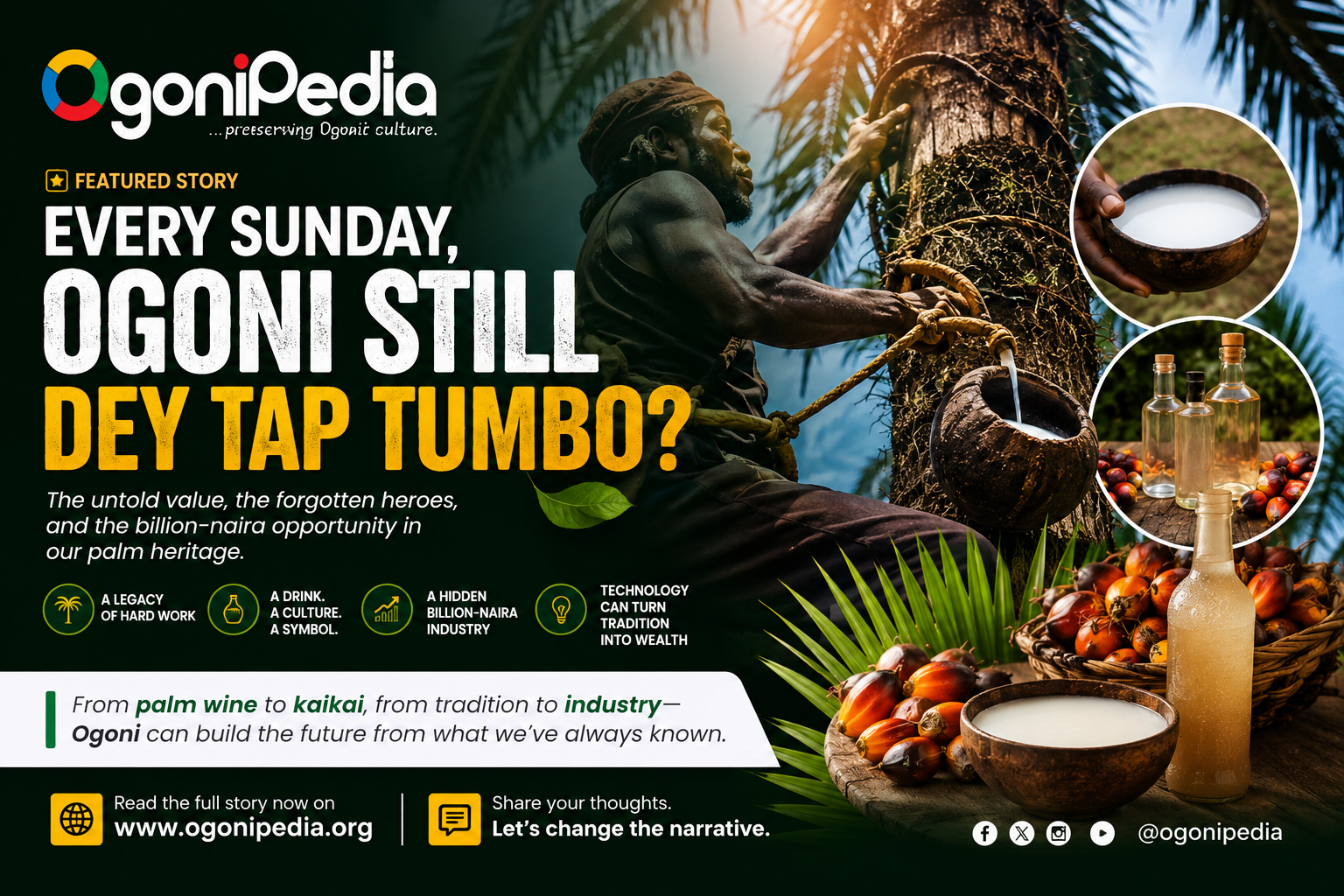
EVERY SUNDAY, OGONI STILL DEY TAP TUMBO?
Rediscovering the Dignity, Enterprise and Economic Value Behind Ogoni’s Palm-Wine Tradition
There was a time growing up when being called a palm-wine tapper was almost an insult.
For some Ogoni children, it was not something they wanted their classmates to know. Some were not proud to tell people what their fathers did for a living. A child could proudly say, “My father is a businessman,” “My father is a civil servant,” or “My father works in the company,” but when the father was a palm-wine tapper, there was sometimes an uncomfortable silence.
Why?
Because somewhere along the line, we allowed ourselves to believe that palm-wine tapping was the occupation of the poor and uneducated.
But history tells us a different story.
OGONI WAS NEVER A LAZY PEOPLE
Long before today's offices, companies, smartphones and digital businesses, our fathers and mothers were already entrepreneurs in their own way.
They were farmers, hunters, fishermen, animal breeders, traders and palm-wine tappers.
They worked the land. They understood seasons. They knew their forests. They understood animals. They planted, harvested, processed and traded.
They didn't necessarily call it entrepreneurship, but that was exactly what it was.
And among these people were the palm-wine tappers.
Every morning, some of our fathers went into the palm groves with their climbing ropes and tapping tools. They climbed trees, collected the fresh wine and brought it home or to the market.
It was hard work.
It was risky work.
It was honest work.
And for many families, that work paid school fees.
SOME OF US WENT TO SCHOOL BECAUSE OUR FATHERS TAPPED PALM WINE
This is the part of the story we must never forget.
Some of the children who were ashamed that their fathers were palm-wine tappers eventually became teachers, engineers, doctors, lawyers, professors, administrators, technologists, entrepreneurs and professionals working in different parts of Nigeria and around the world.
Their fathers may not have worn suits to work.
They may not have sat behind an office desk.
They may not have received monthly salaries.
But they climbed those palm trees so their children could climb a different ladder.
The father climbed the palm tree.
The child climbed the educational ladder.
That is not a story of poverty.
That is a story of sacrifice.
A palm-wine tapper who used the proceeds of his labour to educate his children was not a failure.
He was an investor in the future.
PALM WINE IS MORE THAN A DRINK
Perhaps one of the greatest mistakes we made was reducing palm wine to just the sweet drink served in a calabash.
Palm wine is much bigger than that.
Fresh palm wine has played an important role in Ogoni social and cultural life for generations. It has featured in marriages, traditional gatherings, celebrations, meetings and other important occasions.
It is not merely a beverage.
It is part of our cultural economy.
And beyond drinking it fresh, the palm economy produces several valuable products and by-products.
This is where the story becomes even more interesting.
FROM PALM WINE TO KAIKAI: THERE IS MONEY IN THE VALUE CHAIN
Palm wine can be processed through fermentation and distillation to produce alcoholic spirits commonly known in parts of Nigeria as Kai-kai or local gin.
Kai-kai has historically been part of local commerce and traditional life, but the bigger lesson is the value chain behind it.
Think about what happens when we stop looking at the palm tree merely as something that gives us wine.
We begin to see:
PALM TREE → PALM FRUIT → PALM WINE → DISTILLED SPIRIT → ETHANOL/ALCOHOL PRODUCTS → OTHER BY-PRODUCTS
And the opportunities don't end there.
The palm itself can support businesses around palm fruits, palm oil, palm kernels, palm kernel products, beverages, traditional products, animal feed, biomass and other forms of processing.
That means the palm tree is not simply a source of something to drink.
It is an economic asset.
THE GLOBAL ECONOMY ALREADY UNDERSTANDS THE VALUE OF PALM
The global palm industry is enormous.
Palm-derived products feed into food production, cosmetics, soaps, household products, industrial materials, biofuels and other manufacturing value chains.
And alcohol derived from agricultural products also has applications far beyond drinking. Ethanol is an important industrial raw material used in areas including solvents, sanitising products, pharmaceuticals, cosmetics, chemicals and fuel-related applications.
So when we laugh at the man climbing a palm tree to collect wine, we should remember that he is standing at the beginning of a potentially much larger agricultural and industrial value chain.
The problem is not that palm-wine tapping has no value.
The problem is that we have not built enough modern businesses around it.
IMAGINE WHAT OGONI CAN DO WITH TECHNOLOGY
Now imagine an Ogoni palm industry that looks completely different from what our fathers knew.
Imagine organised palm plantations.
Imagine professionally trained palm farmers and tappers.
Imagine safe climbing technology.
Imagine cooperatives that aggregate fresh palm wine from hundreds of producers.
Imagine hygienic collection and preservation systems.
Imagine bottled and branded Ogoni palm wine.
Imagine palm wine being processed into premium beverages.
Imagine modern distilleries producing properly regulated spirits and industrial ethanol.
Imagine palm fruits, palm kernels and other by-products being processed locally.
Imagine Ogoni youth working as agricultural technologists, machine operators, food scientists, marketers, logistics providers, quality-control officers, engineers, researchers and business owners within the palm value chain.
That is no longer simply “palm-wine tapping.”
That is an industry.
WHAT IF THE PALM-WINE TAPPER BECAME A CEO?
This is the mindset we need to change.
Our fathers were often operating at the bottom of a value chain because they lacked the technology, capital, processing facilities, packaging, branding and market access available today.
But we don't have to remain there.
The man who once climbed ten palm trees every morning to collect wine could become the owner of a palm plantation.
The palm-wine collector could become a supplier.
The supplier could become a processor.
The processor could build a brand.
The brand could employ hundreds of people.
And the business could eventually become an Ogoni-owned agricultural and manufacturing company.
Same palm.
Different technology.
Different mindset.
Different economic outcome.
LET US ALSO TALK ABOUT THE CHILD WHO WAS ASHAMED
Some children were not proud of their fathers because they were palm-wine tappers.
Perhaps they watched their fathers return home tired and wished they had a different occupation.
Perhaps they were embarrassed when friends discovered what their fathers did.
Perhaps they thought their fathers were poor because they worked with their hands.
But years later, many of those children discovered something important:
Their father's hands were the reason they had an opportunity.
Those hands that climbed palm trees also paid school fees.
Those hands that carried gallons of palm wine also bought textbooks.
Those hands that smelled of palm wine helped build houses.
Those hands provided food.
Those hands raised children.
Those hands helped produce graduates.
And perhaps the greatest irony is that the child who once felt embarrassed by the palm-wine tapper may today be working in an office, running a business or living abroad—because of the sacrifice of that same man.
So perhaps we owe our fathers an apology.
Not because palm-wine tapping was something shameful.
But because we were too young to understand the dignity of their sacrifice.
EVERY SUNDAY, OGONI STILL DEY TAP TUMBO?
So, every Sunday, Ogoni still dey tap tumbo?
Maybe the question is no longer simply about whether people are still climbing palm trees.
The bigger question is:
Will Ogoni tap the economic opportunity that comes with the palm?
We should not romanticise poverty.
We should not tell our young people that they must remain in traditional methods simply because our ancestors did it that way.
Rather, we should take the wisdom of the old generation and combine it with the technology of the new generation.
Our fathers had the palm trees.
We have the technology.
They had the knowledge of the land.
We have access to markets, science, finance, branding and digital tools.
They tapped the wine.
We can build the industry.
LET US CHANGE THE NARRATIVE
The next time someone says, “Your people are palm-wine tappers,” don't be ashamed.
Tell them:
“Yes. And our people used the palm tree to feed families, educate children and sustain communities.”
Then tell them something else:
“We are not just interested in tapping palm wine anymore. We are interested in building an industry around the palm.”
There is dignity in honest work.
There is dignity in farming.
There is dignity in craftsmanship.
There is dignity in palm-wine tapping.
And there is dignity in transforming the traditional knowledge of our ancestors into modern businesses that create wealth and jobs.
Perhaps the palm-wine tapper of yesterday was not poor because he climbed palm trees.
Perhaps he was simply an entrepreneur operating without the technology and language of modern entrepreneurship.
And perhaps the real challenge before us today is to ensure that his grandchildren don't merely inherit his palm trees.
They should inherit the industry.
Moral
Our trade is our pride.
Source / Origin
My own experience